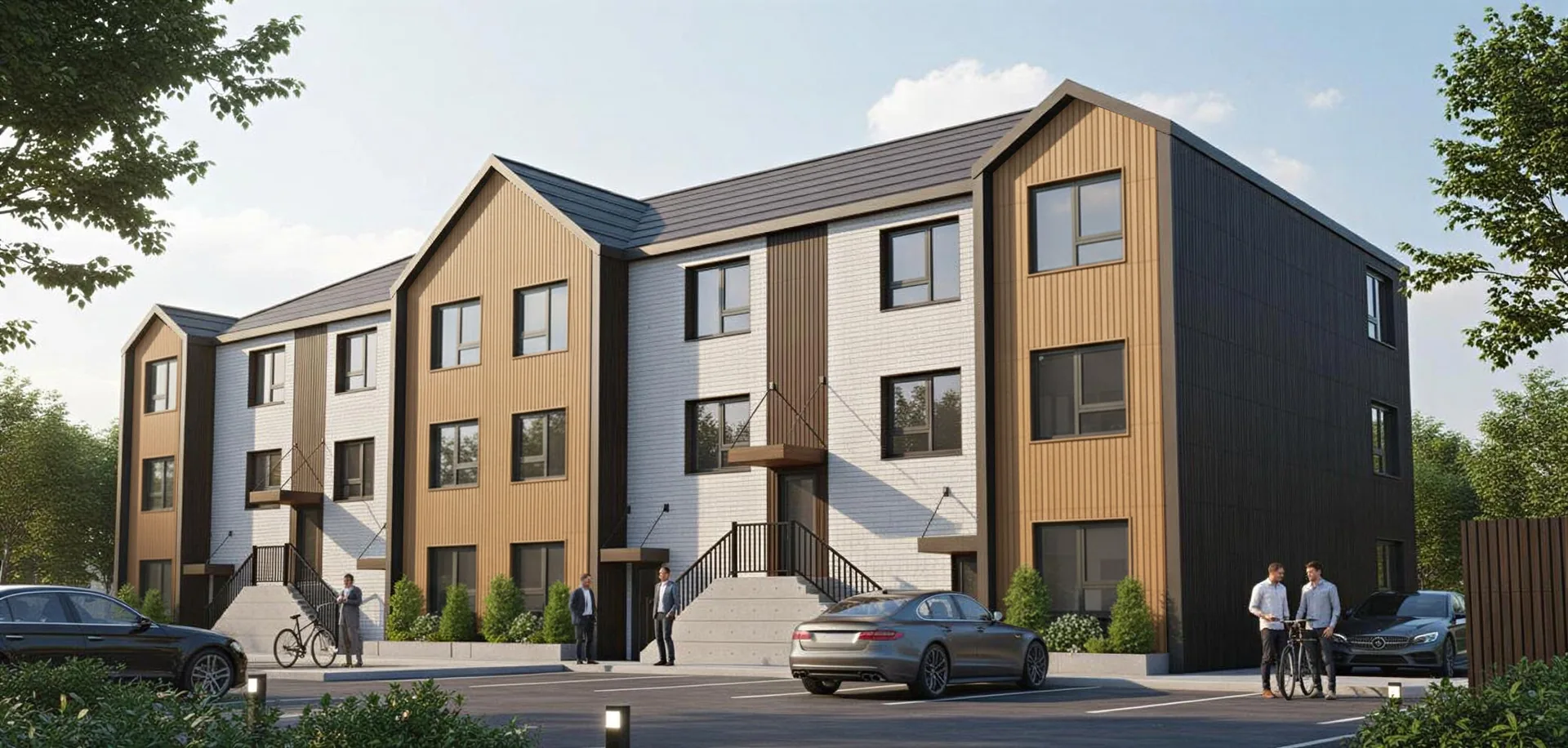
Why Development Timelines Vary So Much
A real estate development in Ontario can take anywhere from a few years to significantly longer, depending on the size of the project, existing zoning, municipal approvals, design complexity, financing, construction method, and market conditions.
Unlike buying an existing property, development is a multi-stage process. A project typically moves through acquisition and due diligence, design, municipal approvals, permitting, financing, construction, occupancy, and stabilization. Some of these stages happen sequentially. Others can overlap.
Understanding where the time actually goes is important for developers, property owners, and investors evaluating a development opportunity. Here is how the process typically unfolds.
What Are the Main Stages of a Real Estate Development?
Although every project is different, most developments move through six broad stages: site acquisition and due diligence, planning, design and municipal approvals, detailed design, permitting and financing, construction, occupancy and lease-up, and stabilization.
The biggest mistake is assuming that construction represents the entire development timeline. In reality, a considerable amount of work happens before construction begins.
Stage 1: Site Acquisition and Due Diligence
Before a developer can determine whether a property should be developed, they need to understand what can actually be built on it. This begins during acquisition and due diligence.
The development team may evaluate factors such as existing zoning, Official Plan designation, permitted density and building height, site dimensions and access, existing buildings or uses, environmental conditions, servicing capacity, transportation requirements, surrounding land uses, and preliminary construction economics.
The objective is not simply to answer whether the site can be purchased. The more important question is whether the intended project can be built there, and whether the economics still work. A site that appears attractive at first glance may become less compelling once servicing requirements, planning restrictions, environmental conditions, or construction constraints are understood.
This is why experienced developers spend considerable time evaluating a property before committing significant capital.
Stage 2: Planning, Design and Municipal Approvals
Once the development strategy has been established, the project moves further into planning and design.
Depending on the site and municipality, this stage may involve architects, planners, civil engineers, structural engineers, mechanical and electrical consultants, landscape architects, transportation consultants, and other specialists. The team develops the project sufficiently to support the required municipal applications.
Depending on the property, approvals could include Zoning By-law Amendments, Official Plan Amendments, Site Plan Control, Minor Variances, severances or consents, and other municipal or agency approvals.
This stage can become one of the largest sources of uncertainty in a development schedule. A project requiring substantial changes to existing planning permissions generally carries more entitlement risk than one where the intended development is already permitted.
Why Zoning Matters to the Timeline
Consider two otherwise similar development sites. The first already permits the proposed building. The second requires a rezoning before the same building can proceed. The physical construction could ultimately be almost identical, but their pre-construction timelines and risk profiles can be very different.
That is why zoning and entitlement risk should be evaluated at the beginning of the development process rather than after a property has been acquired.
Stage 3: Detailed Design, Permitting and Financing
Receiving a planning approval does not necessarily mean construction begins the following day. The development team still needs to convert the approved concept into a coordinated building that can actually be constructed.
This can include architectural construction drawings, structural engineering, mechanical and electrical engineering, civil engineering, building-code coordination, energy modelling, construction costing, contractor procurement, building-permit submissions, and financing and lender requirements.
This stage is also where seemingly small design decisions can have major consequences. Building dimensions, structural grids, mechanical systems, parking layouts, material choices, and unit configurations can all affect construction cost and feasibility.
For this reason, design should not be treated as something separate from development economics. The building being designed is also the investment being underwritten.
Stage 4: Construction
Construction is usually the most visible stage of development, but it comes after a substantial amount of work has already taken place.
For a multifamily development, construction may include site preparation, excavation, foundations, structural construction, building envelope, mechanical and electrical systems, interior construction, finishes, landscaping, and testing and commissioning.
The construction schedule depends heavily on the building type, scale, construction method, availability of trades and materials, weather, and site conditions.
Ontario developments can also face broader construction challenges. In Biosis' June 2026 presentation on housing construction, we identified several recurring pressures affecting projects, including elevated land and financing costs, lengthy approval processes, material-price volatility, skilled-labour shortages, weather delays, site congestion, trade sequencing, and logistics.
These factors help explain why a development schedule cannot simply be estimated by counting the months required to physically construct a building.
Can Modular Construction Shorten the Development Timeline?
Potentially, yes.
One of the limitations of conventional construction is that many activities occur sequentially. The project progresses from foundations to structure, enclosure, interior work, and finishes, with later trades often dependent on earlier work being completed.
Modular and prefabricated construction can change part of that sequence. Components of a building can be manufactured in a controlled environment while certain activities are occurring at the development site. This means off-site production and on-site construction can happen concurrently rather than entirely sequentially. That overlap can potentially compress the construction schedule.
Why Biosis Is Exploring Modular Construction
Biosis is applying this approach to Mandevilla, a planned 64-unit, six-storey purpose-built rental development at 2121 St. Laurent Boulevard in Ottawa. Our June 2026 investor presentation examined modular construction specifically in the context of this development and the broader challenges facing housing construction.
The objective is not simply to build faster. The broader opportunity is to improve the predictability of the construction process by addressing schedule, quality control, weather exposure, labour and coordination, and cost certainty.
- Schedule: Factory production can overlap with certain activities happening on the development site.
- Quality control: More work can occur in a controlled manufacturing environment rather than under changing site conditions.
- Weather exposure: Moving portions of construction indoors can reduce dependence on favourable weather.
- Labour and coordination: Prefabrication can reduce some of the site-bound work and trade sequencing that conventional projects require.
- Cost certainty: Earlier coordination and procurement may help reduce some forms of construction uncertainty.
The distinction is important, however: modular construction does not eliminate the development process. A modular project still requires appropriate land, due diligence, design, engineering, approvals, financing, permits, site preparation, and ultimately occupancy. What modular construction can change is how portions of the construction stage are executed. That makes it one potential tool for reducing the time between construction commencement and a completed, revenue-producing building.
Stage 5: Occupancy and Lease-Up
Completing construction is not necessarily the end of the development process. Before residents can occupy the building, various inspections, testing, commissioning, and municipal requirements may need to be completed.
For a purpose-built rental development, the project then moves into lease-up. This involves progressively filling the building with tenants. The amount of time required depends on factors such as number of units, local rental demand, unit mix, rental rates, seasonality, marketing strategy, competition from nearby properties, and the pace at which completed units become available.
For an investor evaluating a development, this distinction matters. Construction completion, occupancy, and stabilization are not necessarily the same date.
Stage 6: Stabilization
A rental development is generally considered stabilized once it has reached a sustainable level of occupancy and operating performance.
At that point, there is significantly more operating history available than there was during development. The project's risk profile therefore changes as it progresses.
During acquisition, much of the value is based on what the site could become. During approvals, uncertainty around what can be built begins to decrease. During construction, the proposed development becomes a physical asset. During lease-up, the market begins demonstrating actual demand for the completed units. At stabilization, the property has become an operating income-producing asset.
This progression is one reason development investing is fundamentally different from purchasing an already stabilized building.
What Causes Real Estate Developments to Take Longer?
Development delays rarely come from a single source. More often, several smaller issues accumulate throughout the project.
Common causes include rezoning or planning changes, municipal review timelines, design revisions, consultant coordination, environmental or servicing issues, financing conditions, building-permit requirements, material availability, skilled-labour shortages, weather, unexpected site conditions, contractor scheduling, and changes in construction costs.
Some of these risks can be reduced through planning. Others cannot be eliminated entirely. The developer's job is therefore not to assume everything will proceed perfectly. It is to identify major risks early and structure the project accordingly.
Can Some Development Stages Happen at the Same Time?
Yes, and this is an important distinction when evaluating a development schedule.
A development timeline should not necessarily be imagined as a strict sequence with every stage waiting for the previous one to finish completely. Well-managed projects can have overlapping workstreams. For example, design may continue while approvals are progressing. Financing discussions may occur during design and permitting. Leasing preparation can begin before construction is complete.
Modular construction takes the same principle into the construction process by allowing certain off-site and on-site activities to occur concurrently. The ability to intelligently overlap activities can materially affect the overall development timeline.
Does a Longer Development Timeline Mean a Worse Investment?
Not necessarily. Speed and quality are not the same thing.
A development that takes longer but successfully navigates approvals, controls its costs, and delivers a building into a strong market may ultimately perform better than a project that moves quickly but was poorly conceived.
For investors, the more useful questions are: What stage is the development currently in? What approvals have already been obtained? What approvals remain? Is the proposed development permitted under the existing zoning? What assumptions does the construction schedule depend on? What could delay construction? Has contingency been incorporated into the schedule? When is occupancy expected? How long is lease-up expected to take? What happens financially if the project takes longer than expected?
A sophisticated development schedule should acknowledge uncertainty rather than hide it.
How Can Developers Reduce Development Timeline Risk?
There is no way to eliminate development risk completely. But developers can reduce unnecessary uncertainty.
One of the most important steps is performing detailed due diligence before acquisition. Understanding zoning, servicing, environmental conditions, construction feasibility, and project economics early can prevent expensive surprises later.
The composition of the development team also matters. Development requires coordination between architecture, engineering, planning, financing, construction, and ownership. When these groups operate independently, decisions made by one discipline can create consequences elsewhere in the project.
At Biosis, our approach is vertically integrated across architecture, engineering, and development. That does not remove the inherent risks of real estate development. It does, however, allow design and development decisions to be evaluated together rather than treating architecture, engineering, and project economics as completely separate exercises.
So, How Long Should You Expect an Ontario Development to Take?
There is no responsible single-number answer. A relatively straightforward project with supportive zoning and limited planning complexity may progress considerably faster than a development requiring rezoning, extensive studies, major infrastructure work, or multiple rounds of approvals.
The better way to evaluate a timeline is therefore stage by stage. Ask: Where is the project today? Then: What still needs to happen before the building can generate revenue? For a development investor, those two questions are much more useful than asking whether development normally takes three years or five.
Every project has a different path. The objective is to understand that path before investing.
Frequently Asked Questions
How long does it take to build an apartment building in Ontario?
The construction period depends on the size, height, building system, site conditions, labour availability, and construction method. Importantly, the construction period is only one part of the overall development timeline. Acquisition, design, approvals, permitting, financing, occupancy, and lease-up also need to be considered.
What takes the longest in real estate development?
There is no universal answer. Municipal approvals can create substantial uncertainty for projects requiring zoning or planning changes, while construction itself can be the longest major stage for other developments.
Can zoning affect a development timeline?
Yes. A project that can be built under existing zoning may have a substantially different approval path from one requiring a Zoning By-law Amendment or other planning changes.
Does modular construction make development faster?
Modular construction can potentially shorten the construction phase because portions of the building can be manufactured off-site while work is happening on-site. However, modular construction does not eliminate requirements such as due diligence, design, engineering, municipal approvals, financing, or permitting.
What happens after construction is finished?
A development may still need final inspections, commissioning, and occupancy approvals. Rental developments then typically move through lease-up before reaching stabilized occupancy and operating performance.
What should investors look for in a development timeline?
Rather than focusing only on the projected completion date, investors should understand the project's current stage, outstanding approvals, construction assumptions, schedule contingencies, expected occupancy date, and stabilization strategy.
Final Thoughts
Real estate development is a process of turning an idea into an operating asset. The timeline begins long before the first excavator arrives and can continue after construction crews leave.
For investors, understanding that process provides a much better framework for evaluating development opportunities. Instead of simply asking "When will it be finished?", ask "What has already been completed, what remains, and what could change the timeline?" That question tells you considerably more about the project and the risks involved.
This article is provided for general informational purposes only. Development requirements and approval processes vary by property, project, municipality, and applicable law. Readers should consult the relevant municipality and qualified professional advisers regarding a specific development.